
Why designers and developers still struggle to work together — and how better products are built
Designers and developers both want to build great products, yet collaboration between design and engineering still breaks down surprisingly often. This article explores the hidden gap between design files and shipped products, why handoff culture creates problems, and how better collaboration leads to more polished user experiences.
Product designers and developers ultimately share the same goal: building products people genuinely enjoy using. Both sides care about solving real problems, improving usability, and creating experiences that feel seamless to end users.
So why does collaboration between design and engineering still feel frustrating so often? And more importantly — how do teams actually improve it?
In the spirit of collaboration, this article was originally co-written with my friend Lisa Jacquiot, a talented Product Designer.
If your product workflow behaves like an assembly line, problems are inevitable
Assembly lines are excellent when the task is repetitive.
Product development is not.
Research, design, engineering, and product decisions involve interpretation, tradeoffs, and continuous thinking. That kind of work breaks down quickly when treated like a factory pipeline.
Yet many teams still work this way.
Researchers hand findings to product managers. Product managers hand specs to designers. Designers hand Figma files to developers.
At that point, your workflow starts looking suspiciously similar to the game Telephone.
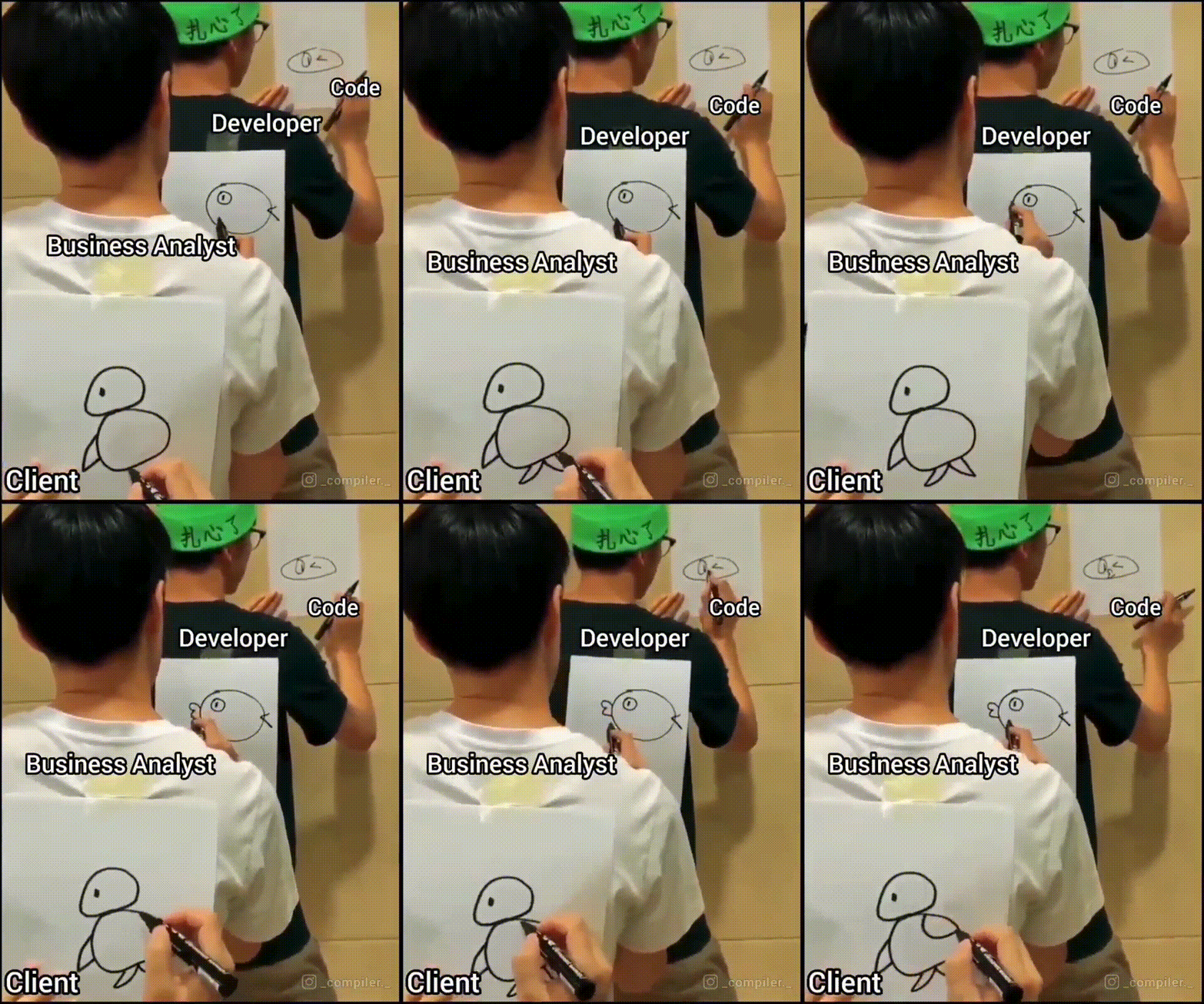
The bigger issue is that teams often fail to use everyone’s strengths effectively.
Product managers, designers, and engineers are all professional problem solvers — but each group approaches problems differently.
The moment any one discipline assumes it already has every answer, blind spots start appearing.
The obvious solution is collaboration earlier and more often.
Not everyone needs to own every decision. But everyone should participate enough to contribute context, constraints, and feedback.
That sounds simple in theory. In practice, asking for feedback is uncomfortable. It takes time. It introduces uncertainty. And if we’re honest, most of us secretly believe our solution is already correct anyway.
But early feedback prevents teams from committing to the wrong direction too late.
It also exposes technical limitations, user concerns, or implementation details that frequently lead to much better ideas.
When starting a project, bring designers, developers, and anyone with useful context into the same conversation early.
Discuss what’s realistic before work becomes too detailed.
And as a designer, don’t disappear into a perfectly isolated creative workflow only to reappear later with finished screens. Schedule short syncs throughout the process.
Explain the reasoning behind design choices. Ask engineers where implementation becomes difficult or fragile.
Likewise, developers should communicate when a design introduces unexpected complexity, unclear states, or technical risks. Often the design can be adjusted without sacrificing the original intent.
The more both sides stay involved, the smaller the gap becomes between the design file and the shipped product.
And over time, teams build something equally important: mutual respect for each other’s craft.
Designers and developers optimize for precision — just in completely different ways
The problem is not only that designers and developers think differently.
Their tools also encourage completely different mental models.
Take a simple login screen.
To a designer, it appears as a single composed interface.
To an engineer, it’s a collection of independent components, states, spacing systems, validations, and layout rules.
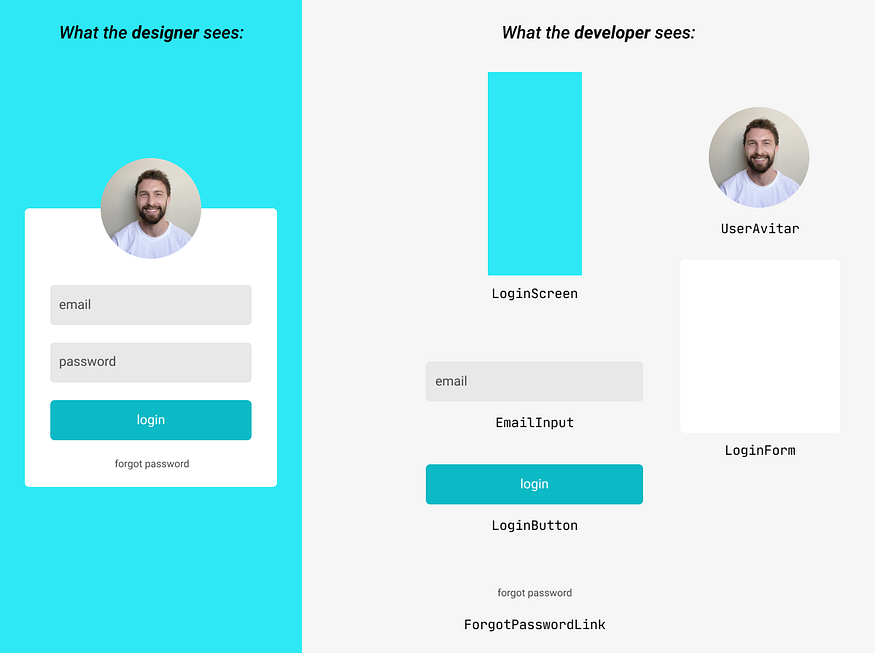
Created by Scott — don’t blame Lisa for this one.
Once implemented, designers notice things immediately:
- spacing feels off,
- colors don’t quite match,
- alignment drifts,
- typography behaves differently.
And internally they think:
“Why can’t you just align the text correctly? It’s right there in the design.”
Meanwhile, developers are solving a completely different set of problems.
Designers think in pixel distances. Developers think in margins, padding, layout systems, and responsive behavior.
That’s largely because our tools force us to think that way.
A designer sees centered text. A developer sees layout edge cases:
- What happens on ultra-wide screens?
- What happens in split screen mode?
- What happens when validation errors appear?
- What happens when localization doubles the text length?
Even something as simple as responsiveness can become deceptive inside design tools.
A responsive grid in Figma may visually suggest flexibility while still being impossible — or extremely fragile — to implement cleanly in code.
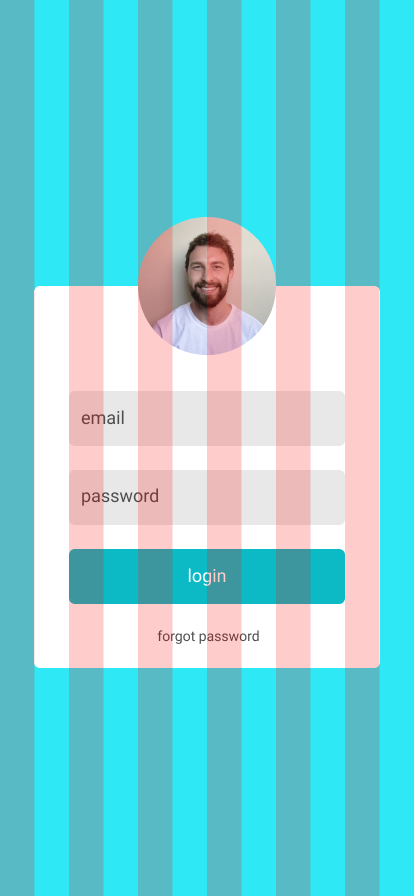
The mismatch becomes even more obvious at the component level.
Take a UserAvatar component built in React.
The component might receive:
firstNamelastNameimage
It generates initials automatically and displays either a profile image or fallback avatar inside a circular container.
From the design perspective, that avatar belongs neatly inside the login layout.
From the engineering perspective, it’s an isolated reusable component with no awareness of the parent layout grid.
The tools push both sides toward different assumptions.
The solution is not more handoff documents
The solution is better shared understanding.
That means:
- clearer user flows,
- interactive prototypes,
- documented edge cases,
- and continuous two-way feedback.
Design for multiple screen sizes and orientations intentionally.
Identify the most common device breakpoints based on your actual users instead of relying entirely on default grid systems.
And don’t expect developers to mentally connect isolated static screens together. That process wastes time and introduces mistakes.
Provide flow diagrams showing how screens connect.
For interactions, create lightweight prototypes that demonstrate:
- loading behavior,
- transitions,
- gestures,
- animations,
- navigation patterns.
Most importantly, design the states people usually forget:
- loading states,
- empty states,
- first-time experiences,
- authentication failures,
- partial content,
- offline behavior,
- error handling.
For many users, these “secondary” states are the real product experience.
And throughout the process, keep feedback loops active.
Design systems help — but only when they exist in code
Design systems often sound like the perfect solution.
And honestly, they can be.
But only when the system exists beyond static documentation.
The real value of a design system appears when it becomes a shared language implemented directly in code.
That’s why component libraries matter so much.
A coded design system allows designers and developers to work with the same building blocks, constraints, and behaviors.
Designers understand how components behave in reality. Developers reuse tested UI patterns instead of rebuilding them repeatedly.
That alignment dramatically reduces inconsistencies between mockups and shipped interfaces.
Of course, there’s a tradeoff.
Building and maintaining a design system requires enormous effort from both design and engineering teams.
A lot more effort than most companies initially expect.
Fortunately, not every team needs a completely custom solution.
Open-source systems like Material Design and Bumbag already provide accessible foundations and reusable UI libraries that encourage strong design practices out of the box.
And for many teams, that’s more than enough.
At the end of the day, designers and developers are not opposing sides.
The best products happen when both groups stop treating collaboration like a handoff — and start treating it like shared problem solving.
Tags
Related posts

React WebRTC: Failed to set remote answer sdp Fix
Spent hours debugging InvalidStateError: Failed to set remote answer sdp in a React WebRTC application using Simple-Peer and Socket.IO. The real issue was not the SDP itself, but duplicated signaling events, incorrect signaling states, and React lifecycle behavior. Here is the actual cause and the fix that finally worked for me.
Why design and engineering still drift apart in modern product teams
Modern product teams still struggle with the gap between design intent and shipped software. This article explores why designers and engineers often see products differently, how handoff culture creates drift, and why design engineering may be the key to building more cohesive digital experiences.

How Designers Can Build Better Collaboration With Engineers
Strong products are rarely built by design or engineering alone. This article explores practical ways designers can collaborate more effectively with engineers, from understanding technical constraints and speaking the same language to improving communication, QA, and product workflows.