Why the best product teams are moving away from design handoffs
Traditional design handoffs often create communication gaps between designers and developers, leading to slow workflows, implementation issues, and products that drift away from the original vision. This article explores why modern product teams are replacing handoff culture with continuous collaboration, shared prototypes, and tighter design-engineering workflows.
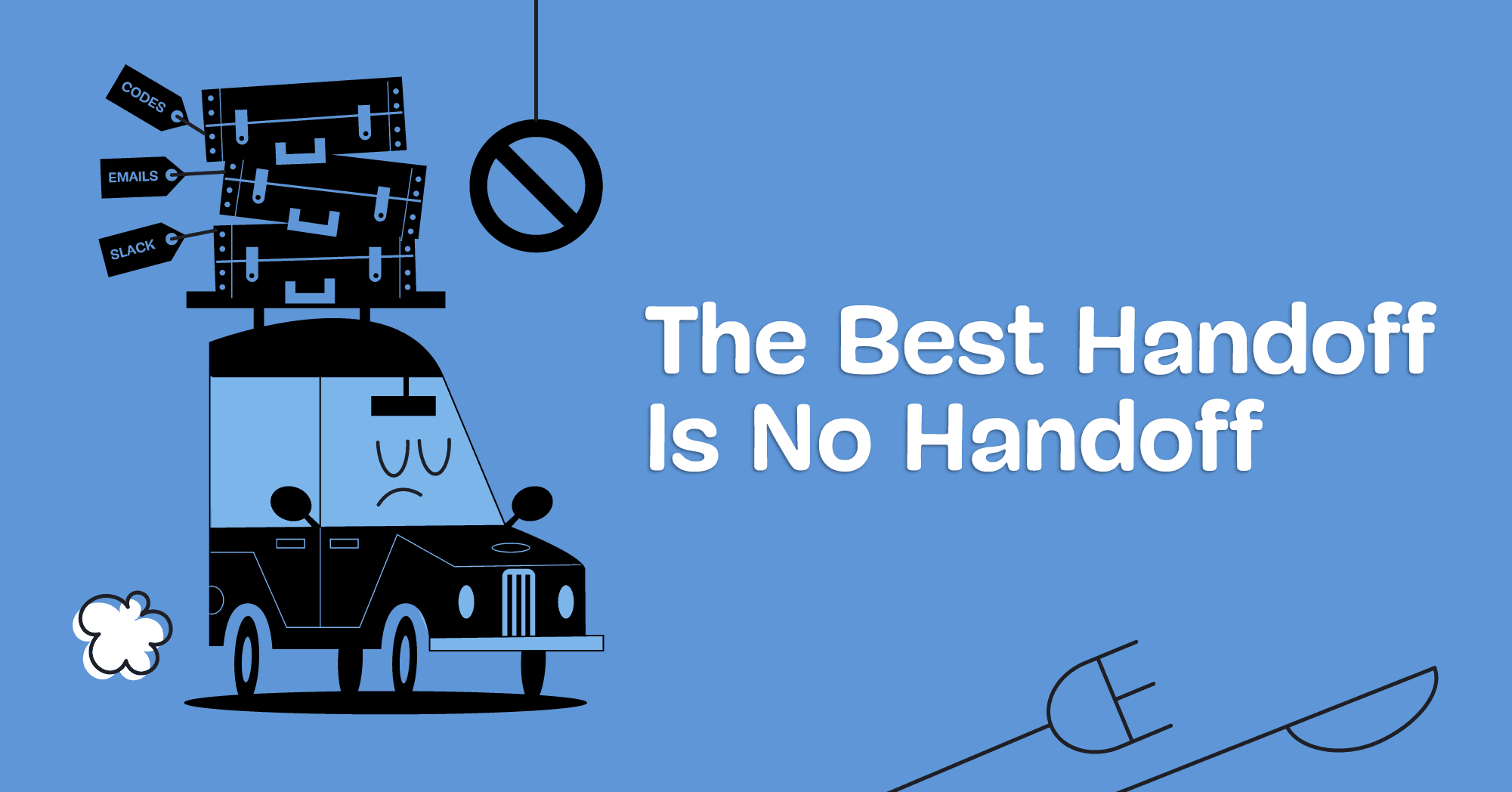
Many companies still organize product work around departments and project pipelines. In larger organizations especially, work constantly moves from one team to another — often getting trapped between meetings, emails, Jira tickets, and Slack threads.
And somewhere in that process, communication slowly degrades between design and engineering.

That naturally leads to the idea of the design handoff: the supposedly clean moment where designers finish their work and developers take over.
In theory, the transition sounds simple.
Designers complete the mockups. Developers implement them. Everyone moves on.
Reality rarely works that way.
Requirements shift. Edge cases appear. Technical constraints emerge. Design adjustments continue long after the “handoff” was supposed to be finished.
And the larger the organization becomes, the more fragile this process usually gets.
The “no handoff” approach
Recently, I came across an interesting article about the no-handoff method that challenges the traditional workflow entirely.
Instead of separating design and engineering into isolated phases, the process becomes fluid and collaborative from the beginning.
Designers and engineers continuously work together through iterative prototyping rather than treating prototypes as something passed downstream after design is “done.”
The traditional Double Diamond process compared to a more fluid “no handoff” workflow.
In this model, the working prototype itself becomes the living specification of the project.
Everyone works from the same artifact. No translation layer is needed. No one waits for “final files.”
The problem space and solution space are explored collaboratively instead of sequentially.
And importantly, the workflow starts organizing itself around the product rather than around the company org chart.
The “hot potato” process
This idea reminded me of the Hot Potato Process created by Dan Mall and Brad Frost.
The concept is simple:
Design ideas move rapidly back and forth between designers and developers throughout the entire product cycle.
Not once. Continuously.
Mockups become prototypes. Prototypes trigger technical discoveries. Technical discoveries reshape design decisions. Design refinements influence implementation again.
The process resembles tossing a hot potato between both sides repeatedly (audio, video).

The “Hot Potato” process encourages constant feedback between design and engineering.
From personal experience, the strongest product collaboration rarely involves formal handoffs at all.
The best teams operate more like shared systems than separate departments.
Work flows naturally from design to engineering and back again while both sides stay actively involved throughout the lifecycle of the product.
Of course, periods of independent work still exist.
But there are also frequent overlaps where both sides review progress, validate assumptions, discuss technical limitations, and prevent future problems before they become expensive.
Create more overlap, not more documentation
Things become more difficult when products involve external agencies, outsourcing, or distributed teams.
Most companies respond by creating more documentation.
Detailed specs. Pixel-perfect files. Massive handoff documents. Extensive design rationale.
Unfortunately, documentation alone rarely solves the real problem.
Design decisions still need to be shaped by technical realities.
And not every beautiful interface can be implemented accessibly, performantly, or maintainably.
This is one reason why polished mockups sometimes become slow, fragile, and inaccessible products after launch.

Engineers can — and often should — contribute directly to design decisions.
The better solution is usually more overlap between teams rather than more documentation between them.
That overlap can look like:
- regular check-ins,
- weekly design reviews,
- shared communication channels,
- visibility into implementation progress,
- usability testing with working prototypes,
- continuous design iteration during development.
The earlier technical concerns appear in the design process, the fewer surprises happen later.
Design is not a department
One of the biggest misconceptions in product development is treating design as something owned exclusively by designers.
In reality, design quality is shaped by everyone involved in the product:
- developers,
- designers,
- product managers,
- marketing teams,
- customer support,
- QA,
- accessibility specialists.
Every decision influences the final user experience.
The more overlap that exists between those perspectives, the stronger the product usually becomes.
Changing the workflow starts small
Of course, changing collaboration culture inside an organization is difficult.
Teams rarely transform overnight.
The easiest approach is starting with a small experiment on a small project.
Choose one feature. Try a more collaborative workflow. Allow designers and developers to work simultaneously instead of sequentially.
Ask questions like:
- What can designers contribute during implementation?
- What can developers contribute during design exploration?
- Which decisions should happen together instead of separately?
Over time, teams often realize something important:
Most product problems are not caused by bad intentions.
They come from isolation.
And if teams already struggle to collaborate effectively, adding another formal handoff process usually won’t solve it.
In many cases, what actually needs to change first is the team culture itself.
You can explore more ideas around UX and product workflows in the Smart Interface Design Patterns library, including their live UX training.
And honestly, that mindset shift may matter more than any workflow framework ever will.
Tags
Related posts
React WebRTC: Failed to set remote answer sdp Fix
Spent hours debugging InvalidStateError: Failed to set remote answer sdp in a React WebRTC application using Simple-Peer and Socket.IO. The real issue was not the SDP itself, but duplicated signaling events, incorrect signaling states, and React lifecycle behavior. Here is the actual cause and the fix that finally worked for me.
Why design and engineering still drift apart in modern product teams
Modern product teams still struggle with the gap between design intent and shipped software. This article explores why designers and engineers often see products differently, how handoff culture creates drift, and why design engineering may be the key to building more cohesive digital experiences.
How Designers Can Build Better Collaboration With Engineers
Strong products are rarely built by design or engineering alone. This article explores practical ways designers can collaborate more effectively with engineers, from understanding technical constraints and speaking the same language to improving communication, QA, and product workflows.