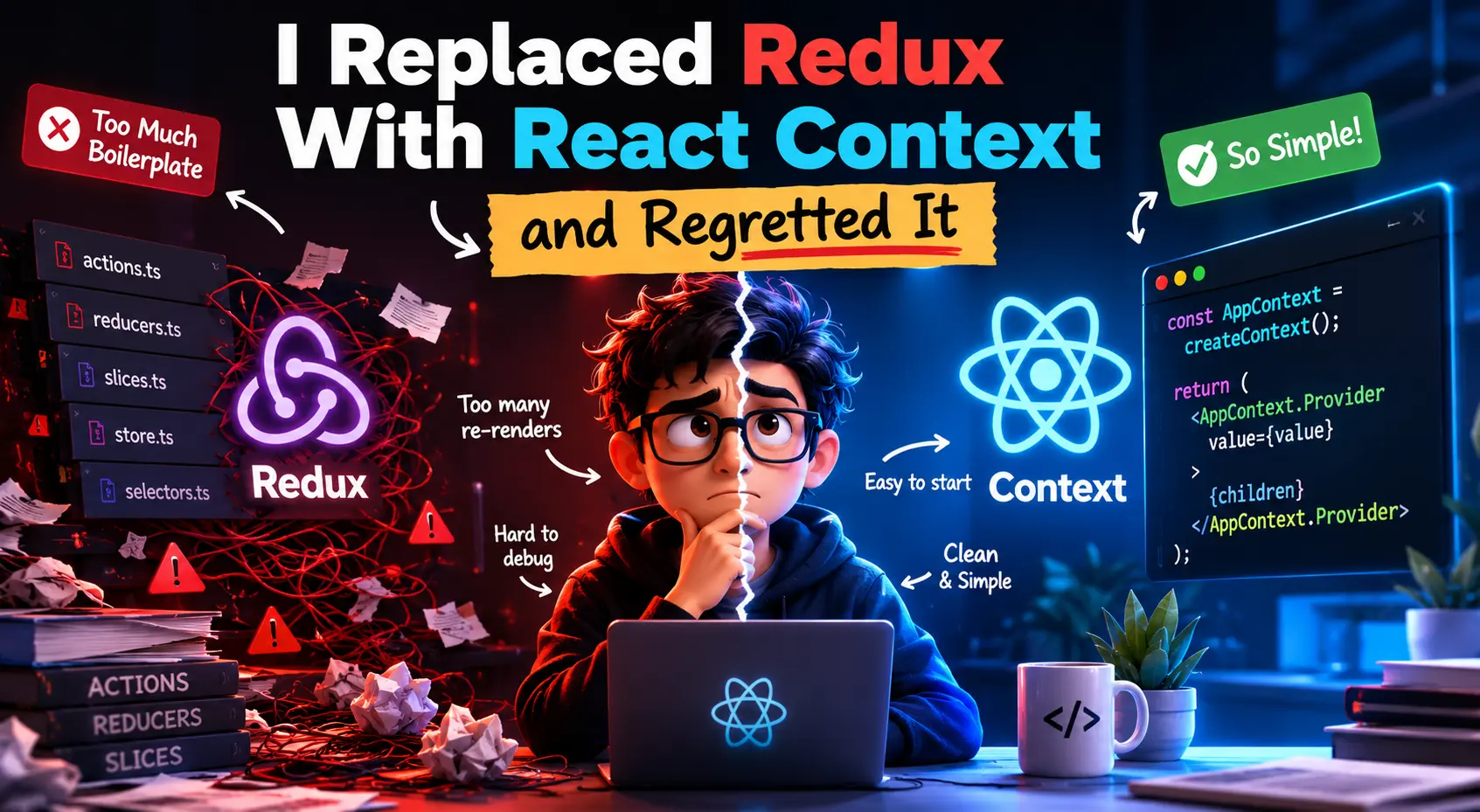
I Replaced Redux With React Context and Regretted It: Lessons From a Growing React App
Can React Context replace Redux? I thought so too. After replacing Redux with React Context in a growing React application, I started running into re-rendering issues, scalability challenges, and unexpected performance problems. Here's what I learned, when Context works well, and when Redux Toolkit is still the better choice.
There was a time when I decided to remove Redux from one of my projects.
The reason was simple.
Redux felt too heavy.
Every time I wanted to add a new piece of state, it seemed like I had to create actions, reducers, slices, selectors, and several files just to store a few values. Meanwhile, React already had Context built in.
I started asking myself:
Why am I using Redux when React already gives me Context for free?
At first, replacing Redux with React Context felt like a great decision.
The codebase became smaller.
There was less boilerplate.
State management looked simpler.
And honestly, it felt more "React-like".
For a while, I was convinced I had found a better solution.
Then the application started growing.
More features were added.
More state needed to be shared.
More components depended on the same data.
And slowly, problems began to appear.
Not dramatic problems.
Not the kind that instantly break production.
The kind that sneak into your project little by little until one day you realize something feels off.
This article is about the lessons I learned after trying to replace Redux completely, why the decision looked brilliant at first, and why I eventually regretted it.
React Context vs Redux
Before going further, it's important to understand that React Context and Redux are not direct competitors.
React Context is primarily designed for sharing data across a component tree.
Redux is designed for managing application state at scale.
At first glance they look similar, which is exactly why many developers, including me, try replacing Redux with Context.
The mistake is assuming they solve exactly the same problem.
In reality, they overlap in some areas, but their strengths become very different as applications grow.
Why React Context looked like the perfect replacement
When developers complain about Redux, they're usually complaining about complexity.
Even with Redux Toolkit making things much easier than before, Redux still introduces concepts that React Context doesn't require.
With Context, getting started is incredibly straightforward.
const AuthContext = createContext(null);
export function AuthProvider({ children }) {
const [user, setUser] = useState(null);
return (
<AuthContext.Provider value={{ user, setUser }}>
{children}
</AuthContext.Provider>
);
}That's it.
No store configuration.
No slices.
No actions.
No reducers.
Just React.
For small projects, it honestly feels amazing.
The simplicity is hard to ignore.
And that simplicity is exactly why so many developers, including me, start wondering whether Redux is still necessary.
Everything worked perfectly at first
The funny thing is that Context actually worked really well in the beginning.
My application wasn't particularly large.
I only had a few pieces of global state:
- authentication
- theme settings
- notifications
Context handled all of that effortlessly.
There were no performance issues.
No architectural concerns.
No obvious downsides.
Every blog post saying "you don't need Redux anymore" seemed completely correct.
For a while, I genuinely believed Redux was becoming obsolete.
Then the project kept growing.
The project became larger than I expected
As new features were added, more state needed to be shared.
What started as a few providers eventually turned into many:
- authentication
- user profiles
- search filters
- dashboard data
- messaging
- notifications
- application settings
Every feature introduced another Context.
Every Context introduced more consumers.
And every consumer increased the number of components depending on shared state.
At this stage, everything still appeared fine on the surface.
The application worked.
Users weren't complaining.
Nothing was obviously broken.
But development was becoming slightly more frustrating.
React Context performance issues
One thing I didn't fully understand at the beginning was how React Context performance changes as an application grows.
In small projects, Context feels incredibly fast.
In larger projects, however, React Context re-render behavior can become difficult to manage.
A single update inside a provider may trigger many consumers to re-render, even when they don't directly use the updated value.
This was the first real scalability problem I encountered after replacing Redux with Context.
The re-render problem hit me harder than expected
Many developers know that Context causes re-renders, but I don't think most people realize how quickly this becomes a problem in larger applications.
Consider this provider:
const value = {
user,
setUser,
};
<AuthContext.Provider value={value}>Whenever the provider re-renders, every consumer of that Context becomes a candidate for re-rendering.
Even components that only use a small portion of the value.
Even components that don't care about the data that changed.
Even components that only use one function from the Context.
This wasn't noticeable when my application was small.
As the component tree grew, however, the impact became much more visible.
Suddenly, a simple state update could trigger far more renders than I expected.
React DevTools was eye-opening
The first time I spent serious time with React DevTools Profiler, I was genuinely surprised.
I expected to find a few inefficient components.
Instead, I found entire sections of the application rendering repeatedly.
A single update could cause dozens of components to render again.
Not because their data changed.
Not because their UI changed.
Simply because the Context value changed.
That was the moment I realized something important:
Context is simple, but it isn't free.
The hidden cost only becomes visible when your application starts scaling.
Context is not really a state management library
This was probably my biggest misunderstanding.
For a long time, I treated Context like a replacement for Redux.
At the time, I was treating React Context as a complete global state management solution.
Looking back, that assumption was probably my biggest mistake.
Context is primarily a mechanism for sharing values throughout a component tree.
Redux is designed specifically for managing application state at scale.
Using Context for a few shared values is great.
Using Context as the primary state management solution for a large application is where things start becoming more complicated.
Redux Toolkit vs React Context
Today, if I start a new project, I don't automatically choose Redux Toolkit or React Context.
Instead, I evaluate:
- the size of the application
- the complexity of the state
- how frequently data changes
- how many developers work on the codebase
For simple applications, Context is often enough.
For larger applications, Redux Toolkit still provides a significantly better developer experience.
What I appreciated after returning to Redux
Eventually, I migrated part of the application back to Redux Toolkit.
Interestingly, the biggest improvement wasn't performance.
It was predictability.
With Redux, components subscribe only to the data they actually need.
const user = useSelector(
state => state.auth.user
);If notifications change, the user component doesn't care.
If settings change, the user component doesn't care.
If dashboard data changes, the user component still doesn't care.
The relationship between state changes and component updates becomes easier to reason about.
And as applications grow, predictability becomes incredibly valuable.
When should you use React Context?
In my experience, React Context works best for:
- authentication
- theme switching
- localization
- feature flags
These values don't change very often and don't require complex state logic.
When should you use Redux?
Redux starts making more sense when:
- multiple features share the same state
- state updates happen frequently
- realtime data is involved
- multiple developers work on the same codebase
- debugging state changes becomes difficult
React Context vs Redux: My rule of thumb
| Scenario | React Context | Redux |
|---|---|---|
| Small Apps | ✅ | ❌ |
| Medium Apps | ✅ | ⚠️ |
| Large Apps | ⚠️ | ✅ |
| Realtime Applications | ❌ | ✅ |
| Authentication | ✅ | ⚠️ |
| Complex State | ❌ | ✅ |
Would I still use React Context?
Absolutely.
In fact, I use Context all the time.
Just not for everything.
Today, I think Context is excellent for things like:
- authentication
- themes
- localization
- feature flags
For larger state management requirements, however, I usually consider alternatives such as:
- Redux Toolkit
- Zustand
- Jotai
The choice depends on the project.
FAQ
Is React Context better than Redux?
Not necessarily.
React Context is simpler and built into React, but Redux scales better for large applications with complex shared state.
Does React Context cause re-renders?
Yes.
When the provider value changes, all consumers can potentially re-render.
This is one of the most common React Context performance issues.
Can React Context replace Redux?
For small and medium-sized applications, absolutely.
For larger applications, the answer depends on the complexity of your global state management requirements.
The lesson I learned
The biggest mistake wasn't using React Context.
The biggest mistake was assuming React Context and Redux were interchangeable.
For small applications, Context can absolutely replace Redux.
For medium-sized applications, it might still work perfectly fine.
For larger applications, however, state management becomes a very different problem.
The challenges aren't about writing less code anymore.
They're about scalability.
Predictability.
Performance.
Developer experience.
Those are the problems Redux was originally created to solve.
And after trying very hard to replace Redux entirely, I finally understood why Redux is still relevant after all these years.
Not because developers enjoy writing extra code.
But because large applications introduce problems that simple solutions eventually struggle to handle.
And unfortunately, that's a lesson I only learned after experiencing it myself.
Tags
Related posts

React WebRTC: Failed to set remote answer sdp Fix
Spent hours debugging InvalidStateError: Failed to set remote answer sdp in a React WebRTC application using Simple-Peer and Socket.IO. The real issue was not the SDP itself, but duplicated signaling events, incorrect signaling states, and React lifecycle behavior. Here is the actual cause and the fix that finally worked for me.

How to Use Google Maps More Effectively With Features Most People Don’t Know About
Most people only use Google Maps to get from point A to point B. But after using it almost every day for years, I realized the app has a lot of small but incredibly useful features that most users completely overlook. From saving parking locations and downloading offline maps to checking Street View before visiting unfamiliar places, these are the Google Maps hacks that have quietly helped me save time, reduce stress, and make everyday travel much more convenient.

Google AI Pro hacks that actually improved my workflow
Recently, I’ve seen a lot of people claiming the student offer for Google AI Pro, but most of them still use it almost exactly like the free version — opening the AI, asking a few basic questions, summarizing documents once in a while, or rewriting short paragraphs. After using it for a while for content writing, research, and studying, I realized the real value of the Pro plan isn’t that the AI is “a little smarter.” The biggest difference is how much smoother and faster it makes your daily workflow.